Menu

Saturday, March 07, 2015

Voices in the crowd at the Selma jubilee

There were some great speeches today at the Edmund Pettus Bridge in Selma, Alabama, as part of the 50th anniversary of Bloody Sunday and all that followed. Here are a few additional thoughts from other everyday people around me in the crowd - which was unlike any other sea of humanity I've ever found myself in, by the way. Incredibly massive, friendly and hope-filled.

68-year-old Erskine McKinnon, who marched 50 years ago, was just ahead of me in line.
"In 1965 I was a student at Alabama A&M University … We were able to come to St. Jude Catholic School and march all the way to the state capitol in Montgomery. So this is something that, after retirement, that I just had to come back to, to reminisce about the time when we were here, in the beginning ... Things have changed, but not changed. I think right now the state of Alabama is going to need to look at more economic development and trying to develop rural communities like Selma and Tuskegee – some of those counties – Dallas, Macon, Wilcox – are some of the poorest counties in the nation as far as minorities. They’re a large population but economic development is not what it should be. So hopefully this gathering at Selma will put a new look at the needs – even though we have the president here, there are some needs that are greater than President Obama as far as economic development and job opportunities."

Olympia Vernon (at right), a high school teacher in Louisiana, brought along three students eager to attend after watching Selma on a recent band trip.

The 11th graders each recited a stanza from Edna St. Vincent Millay's 1934 poem "Conscientious Objector," which begins, "I shall die, but that is all that I shall do for Death. / I hear him leading his horse out of the stall; I hear the clatter on the barn-floor. / He is in haste; he has business in Cuba, business in the Balkans, many calls to make this morning. But I will not hold the bridle while he clinches the girth. And he may mount by himself: I will not give him a leg up."

High school sophomore Terrance Allen traveled in from Demopolis, Alabama, to understand more of the history of the civil rights movement. The situation in Ferguson, Missouri, also spurred him to attend.

"I have to come out and support, because there were people who didn't have the right to vote, and here today I have the right to vote ... we need to move forward and not take two steps back or ten steps back."
 
Eldridge Allen of Covington, Louisiana, told me he's struck by how "we're still so divided in this country."

"An event like this is great, but you don’t stop for one day. It should happen every day. And every day a person should voice their opinion about the ills in this country. They always say 'black and white,' but I try not to use that, because if you look at each and every individual as a human being,then, you know,  you have more respect for that person.  It doesn’t matter what color you are, what kind of job you have, where you live – you're still a human being. When my kids were small, I used to tell them, ‘When you leave out of this door, you're representatives of this family. And you have to treat and respect everybody that you come across. And I think if our whole of society would start doing that, I think we would have a whole lot better country than we have now, that’s divided. You don’t have to look any further than the Democrats and Republicans in Congress."

Beverly Bunting of Slidell, Louisiana, said it was a historic moment for her (at right, below).

"I felt like this would be something I could tell my grandchildren and children about."

Two students from an interfaith group in Boston each described the experience of being in Selma as surreal. The one pictured on the far left, below, called it sacred ground.

"I think that the battle against discrimination, the battle for racial equality – when it comes to policy and healthcare policy, educational access, urban development and the disenfranchisement of economically underprivileged folks, and also the criminal justice system and law enforcement – there are a lot of issues still to be tackled. I think it gets overwhelming to think of them all at the same time, but as long as we sort of find our niche, whether it’s through interfaith work, social work, policy related, or teaching, I think everyone plays a part."

Laura Hill, at far right in the picture above, is with the League of Women Voters and met up with friend Carey Cauthen (second from right).

"I was registering people to vote before I turned 18," Laura said. "And the first thing I did when I turned 18 was register to vote. Voting rights is what’s driven me for most of my life ... I am grateful to the people who experienced the trauma and the heartache on this bridge 50 years ago, because it changed the world I grew up in, and it’s a better world … I love seeing all the people here from across the state and around the country. It seems like so many decided like within the past week or two to do it, and it’s just really exciting."


Sunday, February 08, 2015

Scenes from the Pet Parade in Soulard

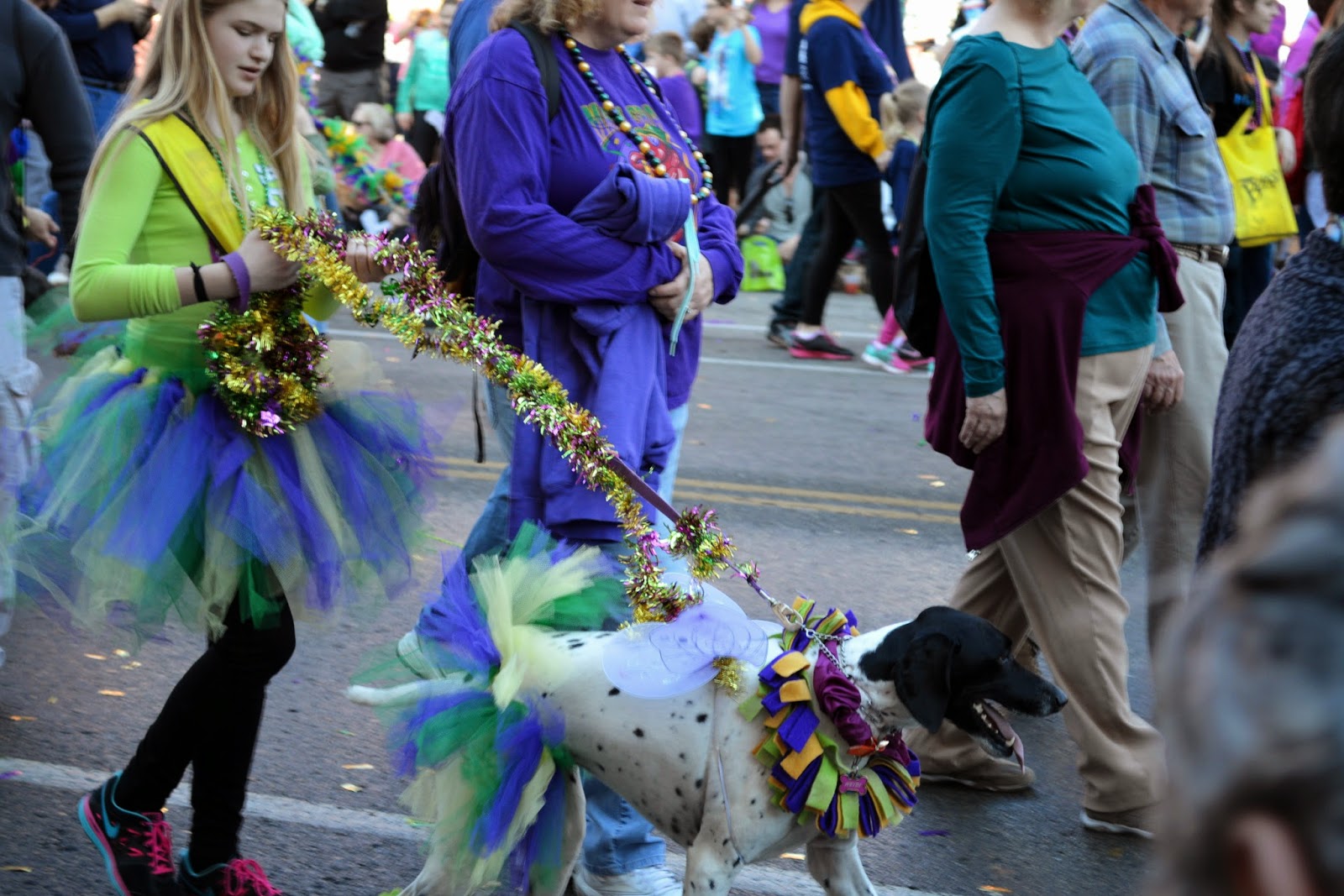
It was a beautiful day for the Mardi Gras Pet Parade in the Soulard neighborhood. We didn't even need coats. Here are a few of my favorite photos from the afternoon - and one PSA.

These guys didn't actually appear to be in the parade, but just look at those faces.

Captain America made an appearance.

This photo is courtesy Joe.

The "love train" definitely stole the show.

 That's a pretty serious costume.

Cool shades.

There were a lot of beads. And a lot of Cardinals gear.

Sometimes I really want a sheepdog. Look at that buddy.

I could also go for a collie...

or a Bernese. Or two. They're basically the dog form of Dash (our cat).

Hello, little miss.

 PSA: This is not appropriate parade behavior. The front of the crowded spectator area is to the left in this picture, where all of us who arrived a half-hour early are standing, on the sidewalk. Halfway through, a bunch of latecomers decided it was fine to completely obscure our view. Not OK, people.

But I don't want to end on a grouchy note, so here are two more happy shots.

Saturday, February 07, 2015

All we expect

Fresh out of college, I found the job of a reporter both trying and satisfying. I relished the opportunity to gather worthwhile information and a variety of perspectives, aiming with each week’s issue of the Westminster Window for a carefully rendered look at a community I’d grown to love.

When Wal-Mart proposed a vast new big-box in a less prosperous part of the suburb, igniting months of opposition among the retailer's would-be neighbors, I spent countless hours and inches of copy capturing the range of clashing voices on the topic. As it evolved from proposal to protest to ballot issue to reality, my role was to observe, inquire, record and communicate.

Approaching something from at least a couple angles wasn't heroic, of course, but simply expected in the newsroom. We sought to maintain its reputation as a trustworthy source of information and to foster a more informed citizenry. And we wanted to get the story right.


Gateway Arch
One thing that the job did not require of me was my opinions about the news. That's not to say I lacked them or was denied them – only that those opinions were beside the point and didn’t often come up. I was busy trying to become "the resident expert" on my beat, as the publisher put it. The other reporters and I left the occasional op-eds to him and the managing editor.

Now, no longer a journalist, I often feel that my opinion is all that is expected, or all we expect from each other. Instead of the demanding yet straightforward tasks associated with getting the story, I’m digesting it, reacting to it, comparing accounts, unsure what to make of it all – yet awkwardly eager to determine where I stand ("Whose side are you on?"). I don't have the luxury of being a witness, the public-service-oriented excuse of being a necessary bystander, so my engagement with the events of the day must take some other form, if any.

Outrage is a common one, and social media brings it to a whole new level. We think-piece ourselves to death, reading and writing the narratives that provide us with the most comfort and personal catharsis possible.

Twin to outrage is a sort of jaded epistemological reinforcement. Another cyclist or pedestrian is killed by a hit-and-run driver here in St. Louis, and I am saddened, but more than anything I am not surprised. It's a validation of my attitude toward drivers as a lot. Or when it turns out that the Republican-controlled U.S. Congress can’t find any wrongdoing on the part of the Obama administration when it comes to Benghazi, it's a smirky satisfaction that I feel, not relief.

But then history marches closer to home, and, for once, more is in fact expected of us. The magnitude of the cognitive dissonance sparked by events here in St. Louis has defied my attempts to mentally collapse it, to file away the discomfort.

Watching parts of the Ferguson community erupt in flames that night in late November, I cried. At the same time, part of me felt that I shouldn’t be sad but angry – and not at the photogenic destruction on TV but rather at the appalling lack of justice, love and social progress around race and poverty.

An Indianapolis family visiting Ferguson
Another part of me has sensed that I should be out in the streets among the peaceful protesters, in solidarity. We lived in Selma, Ala., when I was small, and my white parents frequently joined the anniversary marches across the Edmund Pettus Bridge a mile from our home and predominantly black church. It was important to them to be present. It mattered.

One recurring thought with which I’ve excused my own absence from the Ferguson-spurred demonstrations is that there is too much shrill rhetoric and generalization, despite the legitimacy of the movement overall. For instance, I can get behind a chant like "Hands up! Don’t shoot!" but not "Fuck the police!" That's a genuine hangup for me (not the f-bomb itself but what feels like a viscerally unhelpful sentiment/demonization), but I’m not sure it should be, given the stakes. I don’t know.

Watching Selma in a St. Louis theater last month was convicting. During the part where the bridge and state highway near my childhood home first loom large (heartbreakingly so) in the film, I couldn't help thinking of the attempts to briefly shut down highways here in St. Louis – or of my initial reaction to those efforts.

"How is that peaceful?" I remember telling friends at one point this fall. "It seems more than 'disruptive' to shut down I-70 [right near work]. That seems threatening and could cause accidents. And it's not going to result in goodwill or changed hearts."

If I'd thought at the time about the Selma-to-Montgomery march and its prelude and repercussions, perhaps I would not have been so quick to react as I did, about the idea of pedestrians-with-a-purpose temporarily taking over a busy roadway. That's not to say that my off-the-cuff concerns weren't somewhat valid, but they also betray an insensitive forgetfulness of history and the bigger picture.

While we often grapple with what to think and how to respond to this or that in our super-connected world, Michael Brown’s death and the aftermath insist on more than my opinions or outrage. I'm not sure what all that "more" is, exactly, but I think it's here to stay. And that's probably a good thing.

Sunday, November 30, 2014

11.30.14 along S. Florissant Road, Ferguson, Mo.


I have a regular appointment in Ferguson, and today I biked there from the MetroLink station as usual. I love this path, the Ted Jones Trail.


 I meant to just grab a cup of coffee or some ice cream at the Whistle Stop before my appointment - didn't want to be a gawker - but I did bring my camera, and I'm glad I did. Like along Grand near my home in the Tower Grove neighborhood, the artwork on the countless boarded-up windows throughout downtown Ferguson was stunning.


Along with the colorful designs and positive messages, it was great to see people interacting. Multiple times, cars pulled over near someone painting to thank them for what they were doing and admire the work.


The three men painting boards on the Whistle Stop were local residents, as were most of the people I spoke with. One of them explained that after the boards are no longer needed, the plan is to auction off the artwork, with proceeds going to help the local business community.


These folks (below) traveled in from Indiana, hoping for justice and peace.


Ferguson Public Library (below) ...


The skies threatened rain in the afternoon, but that didn't keep this boy from adding a chalk message of his own.


City Hall ...


"When I was a boy and I would see scary things in the news, my mother would say to me, 'Look for the helpers. You will always find people who are helping' ... there are still so many helpers – so many caring people in this world." -Mr. Rogers